
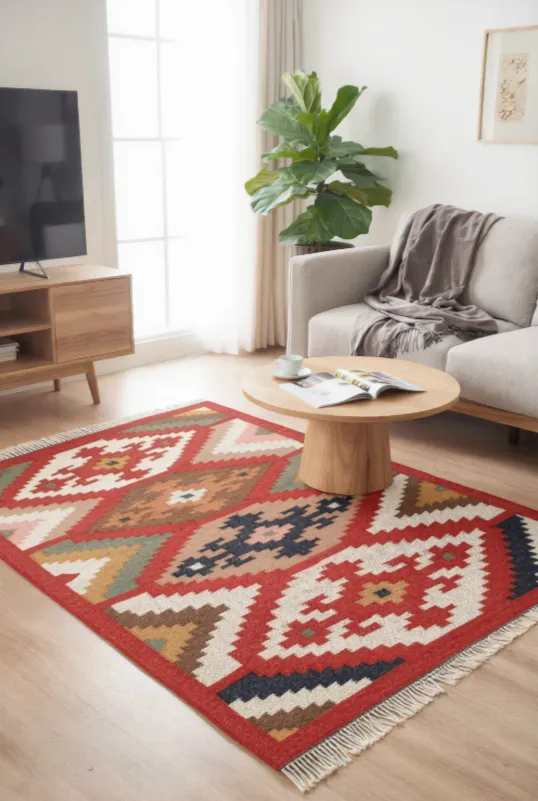
Walk into most rug showrooms and the conversation gets dominated fast. Hand-knotted, for the heirloom buyers. Hand-tufted, for the plush, photograph-ready living rooms. Somewhere in the background sit hand woven rugs, quieter, less talked about, often assumed to be the budget option you settle for rather than the one you actually want. That assumption falls apart once you understand what this construction was actually built to do.
What makes hand woven carpets different from the other two
Hand-knotted rugs are tied knot by knot around a warp on a loom. It can take months to finish one. The pile depth that results is real, dense, the kind that genuinely feels different underfoot.
Hand-tufted rugs work faster. A tufting gun punches yarn through canvas backing, plush comes quick, and a layer of latex holds the whole thing together from underneath.
Hand woven carpets skip both methods. No knot. No gun. No glue anywhere in the construction. A weaver simply interlaces warp and weft directly on the loom, and whatever pattern emerges comes from that interlacing itself, never from carving or shaping a pile afterward.
No pile means no depth in the usual sense people associate with luxury rugs. It also means nothing to degrade. No latex backing breaking down after fifteen years. Nothing glued in that eventually works loose. The weave is the rug, start to finish, which is a genuinely different proposition from the other two techniques.
Why hand woven rugs quietly win in specific rooms
Flat. Low profile. Reversible in many cases, since the pattern shows on both sides. That combination does something neither hand-knotted nor hand-tufted manages quite as well. A flatweave rug sits flush, doesn’t catch a chair leg, dries fast if something spills across it. An entryway. A kitchen. A dining room where chairs get pulled in and out fifty times a week. These are rooms where a thick, plush pile actually works against the space rather than for it, snagging, trapping moisture, wearing thin in exactly the spots where feet land hardest.
A hand woven carpet under a dining table solves a problem hand-knotted rugs were never really built to solve. Chairs slide instead of catching. Crumbs and spills lift off a flat weave far more easily than they sink into a dense pile. None of this makes the construction lesser. It makes it suited to an entirely different job, the way good boots and good running shoes both earn their place without ever competing for the same purpose.
The honest tradeoff worth knowing before you buy
Longevity belongs to the hand-knotted carpet. Decades, sometimes generations, assuming someone actually takes care of it. Comfort and design freedom mostly belong to hand-tufted pieces instead. Curved lines and intricate shading can’t be reproduced given how it’s constructed.
Hand woven rugs trade away a bit of both of those in exchange for something else entirely: less weight to deal with, faster cleanup, a surface that holds up wherever a room actually sees daily movement rather than occasional admiration.
This isn’t really a hierarchy so much as a different brief entirely. A hand-knotted piece anchoring a formal living room and a hand-woven kilim doing the daily work of a hallway runner were never competing for the same job in the first place.
Where hand woven carpets for the home tend to land best
Entryways and hallways, where a handmade rug needs to survive constant footfall without showing every step within a month. Kitchens, where a flat surface means spills lift up rather than sink in. Dining rooms, for the chair movement alone. Layered under a coffee table over a larger base rug, a hand woven piece in jute or wool adds texture without adding bulk, which matters more in smaller rooms than people tend to expect.
Bedrooms and quiet reading corners work well too, particularly with wool hand woven rugs, where the lighter weight and natural fibre still bring warmth without the investment of a fully knotted rug in a room that sees far less wear to begin with.
Shop hand woven rugs and carpets at Kesari Home
Kesari Home’s hand woven collection runs largely through jute, alongside wool and cotton pieces, each one interlaced by hand on a loom by artisans working in techniques passed down across generations in India’s weaving regions.
These handmade rugs aren’t positioned as the lesser alternative to the hand-knotted or hand-tufted pieces elsewhere in the collection. They’re built for the rooms that actually call for this kind of construction: durable, low-profile, textured without excess, doing quiet, dependable work in spaces where plush pile was never really the right answer to begin with.
Browse the full hand woven rugs collection to find a piece sized and woven for the room that needs it most, or get in touch with the Kesari Home team for guidance on matching construction to space before you buy.


